Codec (DMNA) Solutions

Better Compression. Without a Trade-Off.

Introducing Digital Media New Algorithm (DMNA)

Watch this demonstration video to see how DMNA can improve video encoding performance by 75% based on H.264 standard, converting a .YUV file to an .MP4 file.

Every video-enabled device lives or dies by the same constraint: how much footage it can capture, compress, and transmit without burning through bandwidth, storage, or power? DMNA is a proprietary codec algorithm that breaks this trade-off. Developed by Dr. Masafumi Tanaka, Visiting Professor at the University of Tokyo, DMNA delivers a mathematically optimized approach to digital media processing that is faster, lighter, and smarter. Now there is a way to more efficiently address the resource challenges of achieving h264 video compression.

TekStart® Group has an exclusive right to distribute this technology across North America.

In real-world testing, DMNA delivered up to a 75% performance improvement with h264 video compression, with lower latency and higher quality at the same bitrate. The same mathematical approach extends across DMNA's full codec portfolio, from HEVC and JPEG XS to MPEG-2, VP9 decoding, and AAC/MP3 audio. Built for OEMs in broadcast and media production, security and surveillance, video conferencing hardware, medical imaging, consumer, and mobile devices, DMNA delivers more performance out of every frame.

One Algorithm, a Full Codec Portfolio

Video, Still-Image, and Audio – As Hardware or Software IP

DMNA doesn't apply to just a single codec. It's a mathematical approach applied across an entire portfolio of compression standards, available as either hardware IP (RTL cores, including FPGA-optimized variants) or software IP (portable C code optimized for ARM, Intel, and other processors). The portfolio of Codec solutions supports:

Video

Compress more, stream faster.
  • H.264/AVC: HW & SW IP
  • H.265/HEVC: HW & SW IP (up to 8K)
  • MPEG-2: SW IP
  • VP9 Decoder: SW IP

Still Image

Visually lossless. Ultra-low latency.
  • JPEG: HW & SW IP
  • JPEG XS: HW & SW IP (sub-millisecond latency)

Audio

Smaller footprint, same quality.
  • AAC-LC: SW IP
  • MP3: SW IP

Whether you need a drop-in hardware core for a new ASIC, an FPGA-ready IP block, or a software library optimized for your existing processor, TekStart can match the right DMNA-powered format and delivery method to your product.

Why Choose DMNA to Optimize Media Processing?

Unmatched Efficiency Across Video-Intensive Industries

TekStart’s DMNA-powered codec solutions transform how video and media data are processed in real-time environments. Applying advanced mathematical principles such as factorization and hierarchical processing enables DMNA to streamline the codec process with greater proficiency, resulting in faster, more efficient video compression and decoding.

Dramatically reducing the computational load for video encoding and decoding delivers:

  • Higher Fidelity – Preserve image and video quality even under bandwidth or hardware constraints
  • Shorter Cycle Time – Process more data faster, minimizing latency and lag
  • Reduced Circuitry Requirements – Reduce hardware complexity with optimized computation

These advantages make a DMNA-powered codec the ideal choice for industries where speed, clarity, and reliability are non-negotiable.
""

Industry Applications

Across video-, image-, and audio-centric systems, performance is often limited by processing requirements, bandwidth availability, and power constraints. DMNA addresses these limitations directly, enabling more efficient, scalable media processing across key application areas. The following industries stand to benefit the most from this new technology, as explained below.

Broadcast & Media Production

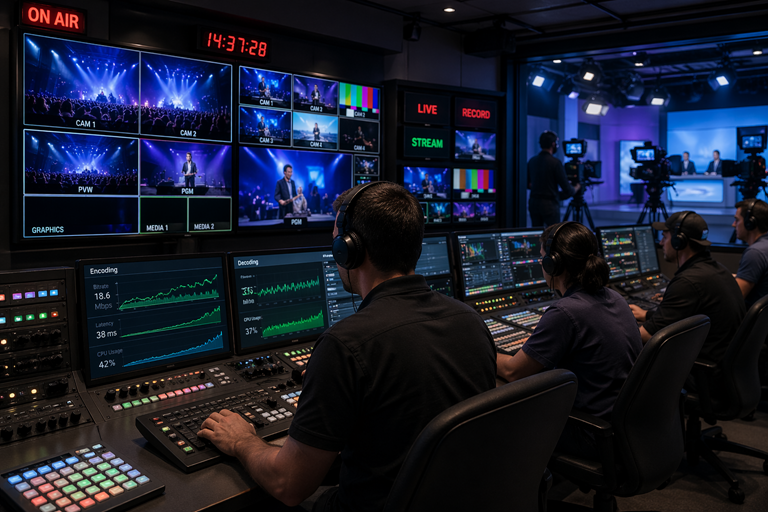
Live video production requires high-resolution processing with minimal latency, where both bandwidth and compute efficiency are critical. DMNA reduces processing load across encoding and decoding functions, from HEVC 8K workflows to MPEG-2 legacy broadcast infrastructure, enabling higher-quality video output and faster throughput without increasing system complexity.

Continuous video capture places significant demands on storage capacity and network bandwidth. By improving compression efficiency across both video streams and JPEG still-frame capture, DMNA reduces data volume while maintaining image clarity, helping to lower storage requirements and optimize system performance at scale.

Modern collaboration systems must deliver consistent video quality across varying network conditions and device constraints. DMNA enables more efficient encoding and decoding, resulting in improved image quality, reduced bandwidth usage, and lower power consumption in compact, always-on devices.

Medical video and imaging applications require high-fidelity data transmission, often over constrained networks and on portable platforms. DMNA, including JPEG XS's visually lossless, sub-millisecond-latency compression, enhances processing efficiency, supporting reliable delivery of detailed visual data while reducing system load and extending device operating time.

Cell phones, tablets, digital cameras, and game consoles all compete for the same limited battery and processing budget. DMNA's software-optimized AAC-LC, MP3, JPEG, and H.264 codecs cut CPU load and power draw without sacrificing audio or image quality, extending battery life across portable consumer electronics.

Remote-controlled and autonomous systems including drones, robots, self-driving vehicles, and infrastructure inspection equipment, depend on ultra-low-latency video to operate safely in real time. DMNA-powered JPEG XS compression minimizes delay to just a few milliseconds, giving operators and onboard systems a near-instantaneous view of camera data.

Royalty-free delivery matters as much as compression efficiency for streaming platforms. DMNA's VP9 decoder, built to the same royalty-free standard YouTube uses, delivers high-quality 4K playback at roughly half the bandwidth of common codecs, without licensing overhead.

""

The DMNA Advantage: Technical Insights
The Mathematics That Redefines Media Processing

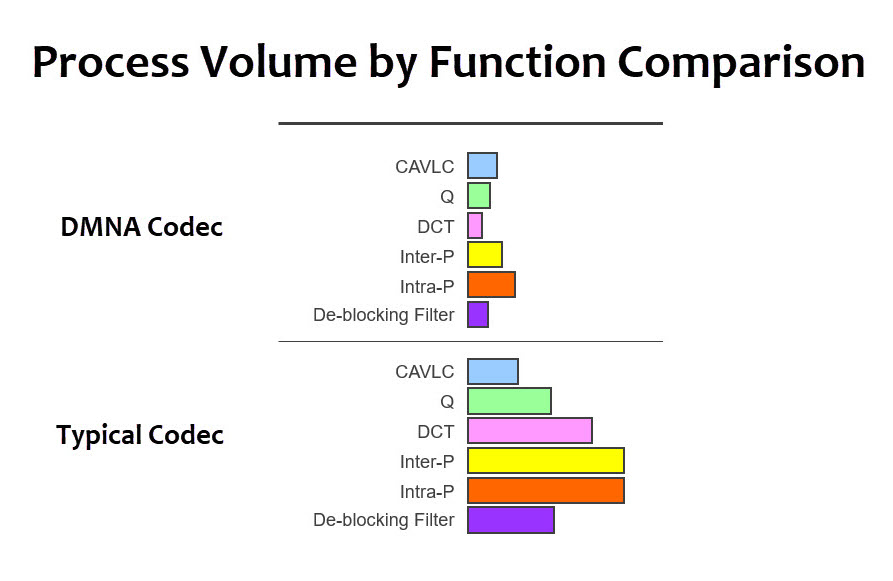
DMNA (Digital Media New Algorithm) was engineered to minimize redundant computation across the video encoding and decoding process. Using advanced mathematical strategies, it achieves significant reductions in processing volume without compromising quality. 

Core Techniques Behind DMNA

  1. Factorization: DMNA simplifies complex mathematical operations by breaking them into smaller, factorized components – reducing computational steps across the codec process.
  2. Wrapping: Through wrapping theory, DMNA effectively narrows the numerical space of operations, allowing data to be processed with fewer total calculations, resulting in faster throughput and lower energy draw.
  3. Hierarchical Structure: By prioritizing essential computations within a hierarchical framework, DMNA executes only the calculations that contribute to output quality, eliminating redundant processes. This hierarchy extends to complex calculus functions, optimizing even advanced transformations.


Impact on Codec Processing Components

When applied to standard video processing stages, DMNA significantly reduces computational load in key functions such as:

  • CAVLC (Context-Adaptive Variable Length Coding)
  • Q (Quantization)
  • DCT (Discrete Cosine Transform)
  • Inter-P and Intra-P Prediction
  • De-blocking Filter

Note that the techniques above are specific to DMNA’s H.264 implementation. HEVC, JPEG XS, and DMNA’s other supported formats apply the same core mathematical principles – factorization, wrapping, hierarchical structure – to each format’s own processing stages. Contact us for format-specific technical details.

Each of the above functions contributes measurable gains in speed and efficiency – translating into smoother playback, faster encoding, and lower system demands.

The Result: Performance That Scales

By leveraging DMNA in this codec offering, TekStart enables you to optimize video, image, and audio processing with reduced resource burden across devices and industries, either as a software- or hardware-based solution. From compact drone controllers to rugged field terminals, this DMNA-powered codec solution delivers efficiency gains rivalling traditional options, without any added complexity.

Ready to Improve Your Codec Performance?

Whether you're building bandwidth-constrained devices or optimizing an existing video pipeline, TekStart Group is ready to help you evaluate a DMNA-based codec.